
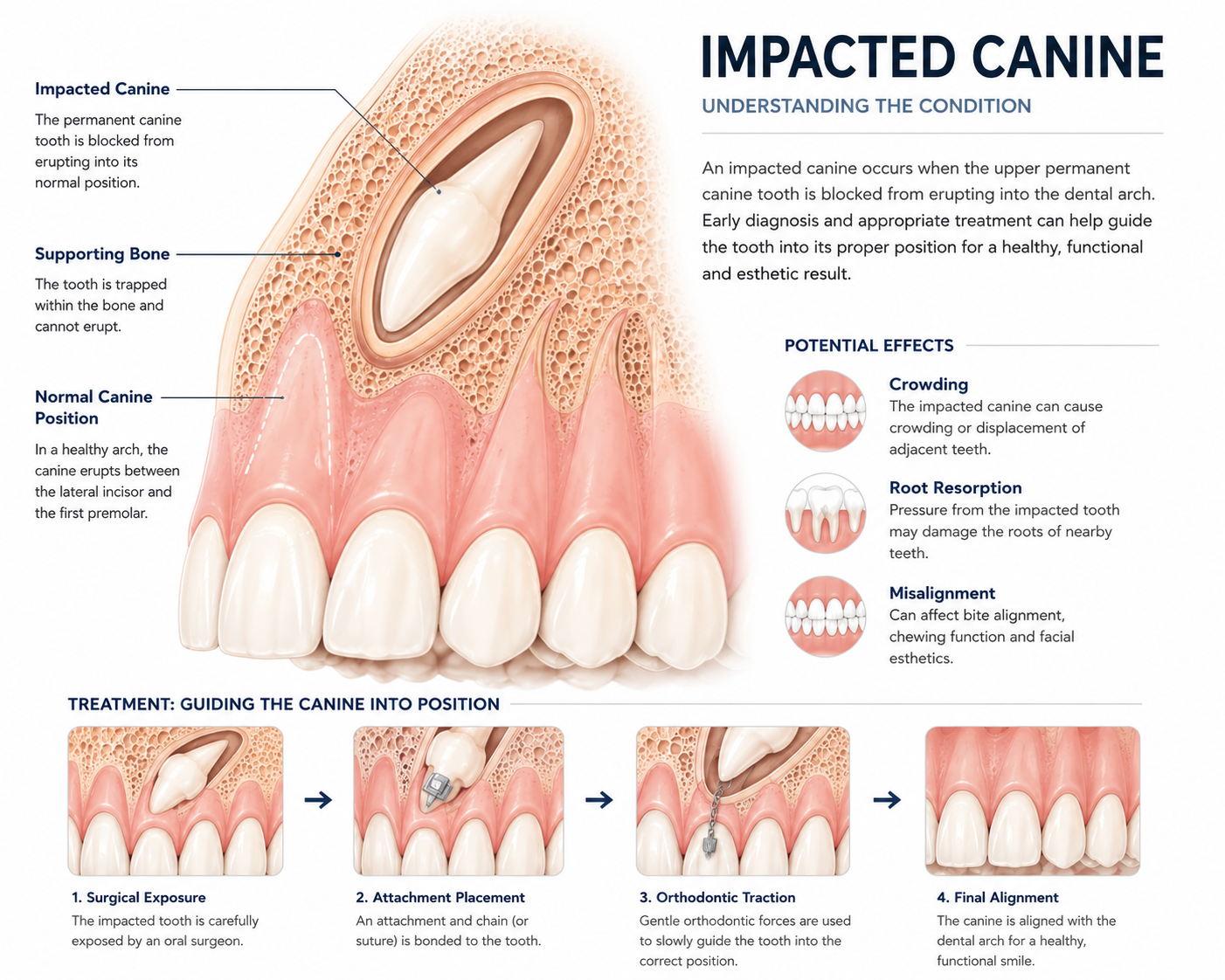
Canine teeth, also known as cuspids or eye teeth, are some of the most important teeth in your mouth. They are the longest-rooted teeth in the dental arch, play a central role in biting and tearing food, and guide the alignment of your upper and lower teeth when you close your jaw. When a canine tooth becomes trapped beneath the gums or bone and cannot erupt into its proper position, it is referred to as impacted. Left untreated, an impacted canine can lead to crowding, damage to neighboring teeth, cyst formation, and lasting effects on your bite. At Wilshire Oral Surgery and Implant Center, our surgeons work closely with your orthodontist to develop a treatment plan that gives your canines the best chance of erupting into place.
Our team is led by Dr. Jonathan R. Shadi and Dr. Saman Vahedi, both graduates of USC’s School of Dentistry and extensively trained in oral and maxillofacial surgery. Dr. Vahedi is a Diplomate of the American Board of Oral and Maxillofacial Surgeons and served as Chief Resident during his training at the University of Nebraska Medical Center. Together, they bring a collaborative, patient-centered approach to every impacted canine case we treat in the Los Angeles area.
Why Canine Teeth Become Impacted
Canine teeth have the longest root of any tooth in your mouth, and they are among the last permanent teeth to erupt, typically around age 11 or 12 for the upper canines. Because they emerge so late and require a significant amount of space, they are the second most commonly impacted teeth after wisdom teeth. Several factors can prevent canines from erupting properly.
Overcrowding
When there is not enough space on the dental arch, canine teeth may have no room to emerge and become trapped beneath the gum.
Baby Teeth That Don’t Fall Out
If primary (baby) teeth remain in place longer than they should, they can block the path the adult canine needs to emerge normally.
Unusual Growths
Soft tissue growths or extra teeth in the arch can physically obstruct the canine’s eruption path, preventing it from reaching its natural position.
Abnormal Tooth Position
The canine may develop at an angle or in the wrong location in the jaw, making normal eruption difficult or impossible without intervention.
Early detection is important. The American Academy of Orthodontists recommends an orthodontic evaluation by age 7, which allows providers to monitor developing canines and intervene before the roots fully form. According to research published by the National Institutes of Health, timely surgical exposure and orthodontic repositioning offers the best outcomes for impacted canines when the root has not yet fully fused with the surrounding bone.
What Happens If Impacted Canines Are Not Treated
The longer an impacted canine remains untreated, the more the root develops and anchors into the bone beneath the gum. Once the root fully matures, typically around ages 13 to 14, the canine is unlikely to erupt on its own, even if space is created. The consequences of leaving an impacted canine in place can compound over time.
Treating impacted canines as early as possible gives you the widest range of options and the simplest recovery.
Treatment Options for Impacted Canines
The right treatment depends on your age, the position of the canine, and how much root development has occurred. Our oral surgeons coordinate directly with your orthodontist to create a plan tailored to your situation.
Orthodontic Space Creation
For younger patients whose canines have not yet fully formed, your orthodontist may use braces or space maintainers to open room on the arch. In some cases, extracting a retained baby tooth provides enough clearance for the adult canine to erupt on its own. We may also refer you to our tooth extractions service if additional extractions are needed to create room.
Surgical Exposure and Bonding
This is the most common treatment for impacted canines. Once your orthodontist has made space, our surgeon will gently lift the gum tissue to expose the canine and bond a small bracket and chain to the tooth. The chain attaches to your braces, and your orthodontist gradually guides the canine into its proper position over several months. We use IV sedation or local anesthesia to keep you comfortable, and surgery does not require an overnight stay.
Extraction and Tooth Replacement
If the canine has been impacted well into adulthood or has fused with the surrounding bone, eruption may no longer be possible. Our surgeons can remove the impacted tooth and plan for replacement. Dental implants are often the most durable long-term option. In some situations, bone grafting may be needed to prepare the site first.
Advanced Imaging for Precise Treatment Planning
Because impacted canines are often positioned at unusual angles deep within the jaw, accurate imaging is essential before any procedure. Our team uses cone-beam 3D imaging (CBCT) to map the exact location of the impacted tooth, the angle of its root, and its relationship to adjacent teeth and bone. This allows us to plan the safest and most direct surgical approach, minimizing recovery time and reducing risk to neighboring teeth.
What to Expect After Treatment
Surgical exposure and bonding is a straightforward outpatient procedure. Here is what the recovery and follow-up period typically looks like.
Frequently Asked Questions
At what age should impacted canines be treated?
The ideal window for treatment is before the canine root has fully formed, typically between ages 10 and 13. At this stage, the root is still developing, the surrounding bone is more flexible, and there is a higher likelihood that exposure and bonding will successfully guide the tooth into place. Treatment after age 13 or 14 is still possible, but may be more complex.
Is the surgical exposure procedure painful?
The procedure is performed under local anesthesia, IV sedation, or general anesthesia depending on your comfort level. Afterward, mild soreness and swelling are normal for the first few days and are typically managed well with over-the-counter medication. Most patients return to school or light activity within a day or two.
Can an impacted canine erupt on its own without treatment?
In some younger patients, creating space through orthodontics or removing a retained baby tooth is enough to allow the canine to erupt naturally. This is most likely to succeed before age 11 or 12. Once the root is more fully formed, surgical exposure is usually necessary.
What happens if an impacted canine is not treated?
Untreated impacted canines can cause crowding and shifting of adjacent teeth, damage to the roots of neighboring teeth, cyst formation, and bite problems. Because canine teeth are critical for proper bite alignment and chewing, leaving an impacted canine in place indefinitely is not recommended.
Does my child need to see an orthodontist before coming to your office?
In many cases, yes. Treating an impacted canine is a coordinated effort between our oral surgeons and your orthodontist. Your orthodontist typically creates space first, and then our team performs the surgical exposure and bonding. If you do not yet have an orthodontist, we are happy to help coordinate a referral.
Can an impacted canine be replaced with a dental implant if it cannot be saved?
Yes. In cases where the canine cannot be brought into position, our surgeons can extract the impacted tooth and plan for dental implant placement. Depending on the condition of the surrounding bone, a bone graft may be performed prior to implant placement.
Schedule a Consultation for Impacted Canines in Los Angeles
Dr. Shadi and Dr. Vahedi have helped many patients in the Los Angeles area address impacted canines with a collaborative approach that prioritizes keeping the natural tooth whenever possible. Whether you are a parent seeking an evaluation for your child or an adult whose canine never came in, we can review your imaging, explain your options clearly, and connect you with the right team members.
Contact Wilshire Oral Surgery and Implant Center today or request an appointment online to schedule your consultation. We are located at 12300 Wilshire Blvd, Suite 326, Los Angeles, CA 90025.