
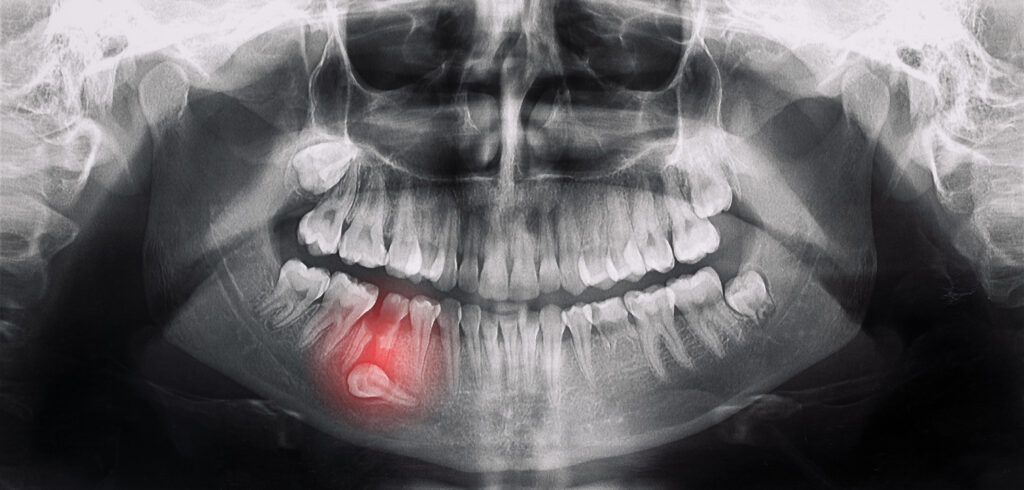
Wisdom teeth usually arrive in the late teens and early twenties, and many people are told to keep an eye on them rather than remove them right away. The problem is that a wisdom tooth without room to erupt does not stay neutral. When there is no pain, waiting feels reasonable, but a quiet tooth can still be shifting neighbors, trapping bacteria, and pressing on nearby structures long before any symptom appears.
This is why timing matters, and it is where Wilshire Oral Surgery and Implant Center focuses its approach. As a full-scope oral and maxillofacial surgery practice in West Los Angeles, we assess each case of wisdom teeth and other tooth extractions individually, using advanced imaging to decide whether removal is warranted and when. We do not overtreat. The aim is to act at the right point so a small issue does not turn into a complicated one.
Why Delay Raises the Risk
A wisdom tooth that cannot fully erupt does not hold its position. It can press on the neighboring molar, crowd other teeth, and form pockets where bacteria collect out of reach of a toothbrush. Over time this leads to decay in healthy teeth, gum inflammation, and repeat infections that are hard to clear without surgery.
There is also a documented link between long-retained impacted teeth and cysts or other jaw pathology. Research indexed through the National Library of Medicine reports that impacted teeth often stay without symptoms and go undetected, which is exactly how complications advance quietly, as noted in a cross-sectional study on awareness of impacted teeth. Timely evaluation is what keeps these silent problems from becoming serious.
How Age Changes the Procedure
Waiting also changes the surgery itself. In younger patients, the roots are often not fully formed and the surrounding bone is more forgiving, which tends to make removal simpler and recovery faster. As the years pass, the roots lengthen and anchor more firmly, sometimes growing close to the nerves in the lower jaw.
When removal is put off into the late twenties and beyond, the procedure can become more involved and the healing period longer. Bone density rises with age, which adds complexity. Later removal is still possible, but the easiest window tends to close earlier than most people expect.
What a Thorough Evaluation Covers
A sound decision starts with the full picture, not just the visible crown. We use cone beam 3D imaging to map the exact position of each tooth, its roots, and its distance from nearby nerves before recommending anything. A complete assessment weighs several factors before we suggest a course of action.
- The angle and depth of the impaction, plus how much room exists in the jaw.
- Signs of decay, infection, or pressure on the adjacent second molar.
- The distance from the roots to the inferior alveolar nerve in the lower jaw.
Reviewing these details together lets us recommend removal only when it serves your long-term health. For patients who need it, we offer IV sedation and general anesthesia for a more comfortable experience. When bone has already been affected, bone grafting can rebuild the foundation for future treatment, including dental implants if a tooth has been lost.
Schedule Your Consultation With Wilshire Oral Surgery and Implant Center
The decision to remove wisdom teeth should rest on facts and careful evaluation rather than guesswork. Our board-certified oral and maxillofacial surgeons bring extensive training and current surgical techniques to every case, with an emphasis on faster recovery and reduced discomfort. We provide a personalized approach in a modern West Los Angeles office, and we offer bilingual care with Spanish and Persian spoken by our team.
If your wisdom teeth have gone unevaluated, the safest next step is a professional assessment before complications develop. You can reach us through our contact form so we can review your situation, answer your questions, and help you decide on the right timing for your care.